 Astro2Astro
Chapter 1
Three friends under the sky
1.1 An evening without electric lights
The day’s work is over. Beyond a small settlement, three friends find a place to sit and watch the sky. As the light fades, stars appear: a few at first, then more than the friends can easily count. Their names are Imaginatrix, Photometrix and Calculatrix. We shall call them Imajoo, Photoo and Calcoo.
Imagine this scene in India about five thousand years ago. The people in it are fictional. We are going to use their evening to explore what a patient observer could discover with no telescope, no clock and no astronomy textbook.
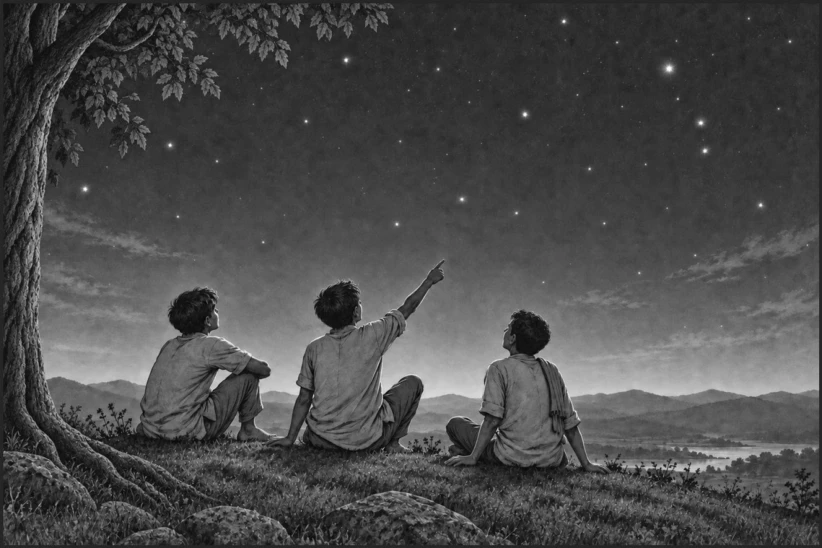
Photoo has a good eye for patterns. Calcoo likes to count and compare. Imajoo is always ready with an explanation, sometimes before the others have finished looking. Each brings something useful. A pattern needs to be noticed, a count needs to be checked, and an explanation gives them something to investigate.
There are no streetlights to wash out the view. To someone used to a bright city, this sky might seem impossibly crowded. Yet the stars visible to the unaided eye are not countless. Even in excellent conditions, only a few thousand can be seen across the whole sky. The ground hides much of that sky at any one moment.
For the friends, the view ends where the sky seems to meet the land. This boundary gives them their first useful reference.
Photoo picks out a small group of bright stars. He remembers the pattern they make. Later in the evening, he looks again. The pattern is still there, but it has shifted across the sky.
“Perhaps the whole sky is turning,” Calcoo suggests. Imajoo pictures a great bowl moving above them. It is an idea they can begin with. Tomorrow they can look again and see whether the stars behave as the picture suggests.
On other evenings, the friends find the same patterns. Most stars keep the same neighbours even as they travel across the sky. We now know that stars move through space, but that motion is usually too small to notice from one night to the next. Over the short periods we are considering, they make a useful background against which to notice other changes.
1.2 Finding a direction in the dark
After watching for several hours, the friends notice something else. In the northern sky, the stars seem to circle a place close to one nearly still star. They have found a pole star: a guide to north.
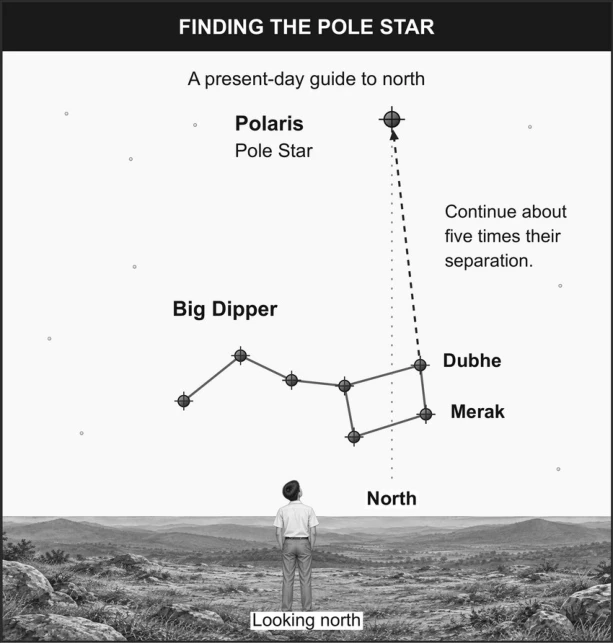
Let us step out of the story for a moment and try a present-day shortcut. From much of India, look for the Big Dipper, a pattern of seven stars. Find the two stars on the outer edge of its bowl: Merak and Dubhe. Follow a line from Merak through Dubhe, extending it about five times the distance between them. You arrive near Polaris, the Pole Star.
Polaris is a useful guide to north. It sits close to the point around which the northern stars appear to turn, although it is not exactly on that point.
1.3 A clock without a dial
The next day brings another puzzle. A stick standing upright in the ground casts a shadow. In the morning it is long. Later it becomes shorter, changes direction, and lengthens again.
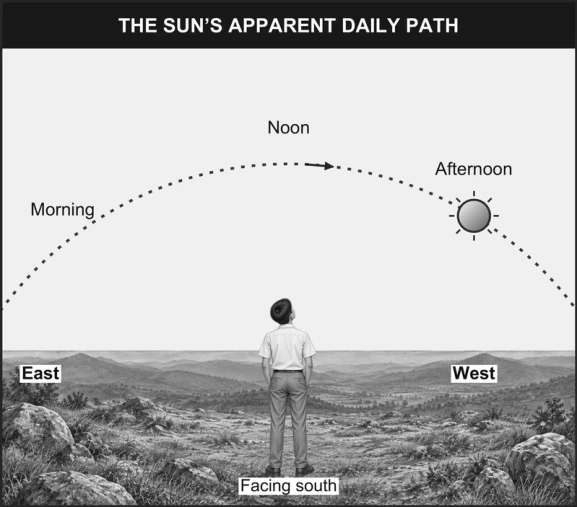
The friends mark its tip at intervals. Somewhere between morning and evening comes the shortest shadow of the day. This gives them a way to recognise roughly when the Sun is highest in their sky. They have begun to make a clock from a stick and a patch of ground.
You can try this experiment too. Choose level ground, make the stick vertical, and mark its shadow several times around noon. Watch the shadow, never the Sun itself. Repeat the observations on another day.
1.4 The Moon refuses to keep the same appointment
One evening, Photoo notices the Moon close to a bright star. When the friends look at about the same time the next evening, the Moon has shifted eastward against the stars. Over the following evenings, its bright shape changes too.
Calcoo now has two things to record: where the Moon is and what it looks like. Those are different observations. Keeping them separate will make the pattern easier to understand.
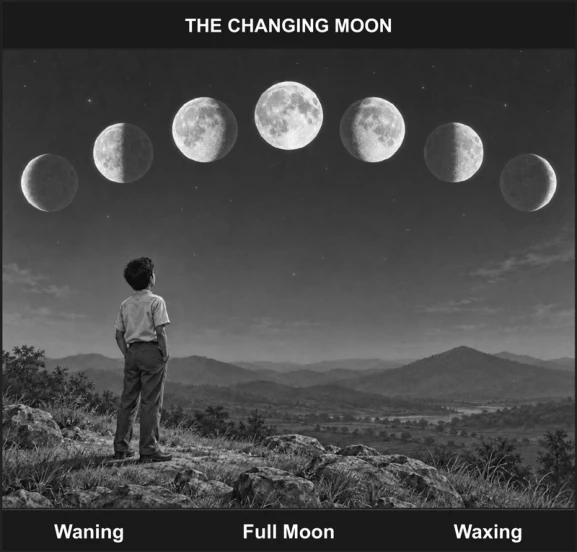
Photoo draws the shape he sees. Calcoo begins counting the days until a similar shape returns. Imajoo wonders whether the Moon itself is growing and shrinking.
We can understand why that explanation might appeal to someone seeing the pattern for the first time.
The friends can put the pattern to use. Bright moonlight may help them travel or arrange a gathering after dark. A returning phase gives them a way to count a longer stretch of time than a single day.
A full cycle takes roughly thirty days. Now the friends can make a plan: “Let us meet here three days after the new Moon.” Their calendar begins with something everyone can watch.
They do not yet need a complete explanation of the Moon to make use of it. Recognising a reliable pattern is already a useful discovery.
1.5 A moving point among familiar stars
Over several weeks, Photoo finds a bright point that refuses to stay in its familiar pattern. The neighbouring stars keep their arrangement, but this point changes position among them. It is another kind of wanderer.
To notice it, the friends must do more than look once. They need to remember where it was and return to the same part of the sky. Their growing collection of observations is becoming as useful as their eyesight.
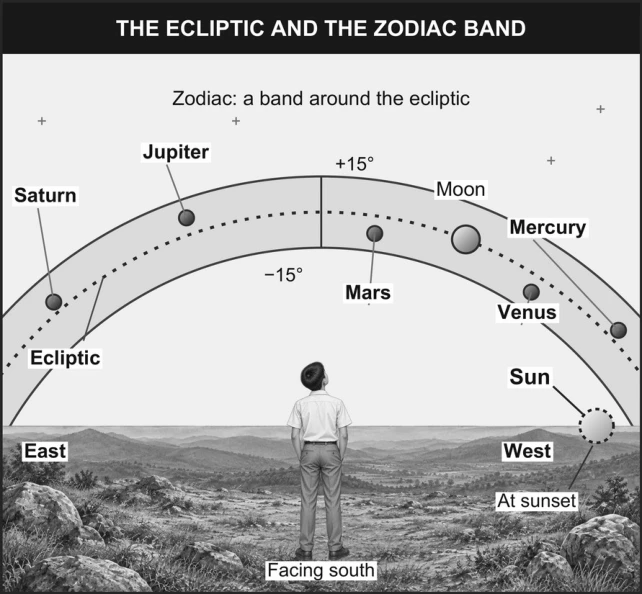
Five planets are familiar to observers without telescopes: Mercury, Venus, Mars, Jupiter and Saturn. Mercury is easy to miss because it stays close to the Sun’s direction in the sky. Venus can be strikingly bright before sunrise or after sunset. The object people call the “morning star” or the “evening star” can, in both cases, be Venus.